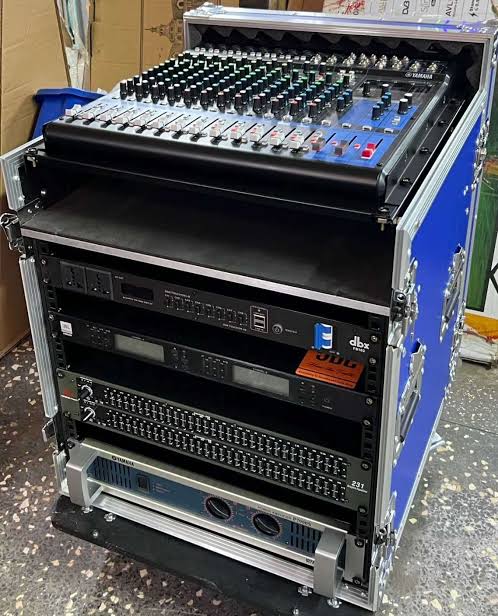
Wiring the Chain: From Fader to Floor
A practical build guide for a mid-size PA rig: a 16-channel Yamaha MG16XU feeding a dbx graphic EQ and crossover, split across two power amps, sequenced onto a 5-box rig of JBL and Electro-Voice boxes. Here's the correct order to connect everything — and why that order matters.
Signal path at a glance: Sources → Mixer → EQ → Crossover → Sequencer → Amps → Speakers
0. The rig
Nine boxes, one signal path. Every unit below is available at City Sounds — follow the links for full specs.
| Role | Item | Quantity | Link |
|---|---|---|---|
| Mixing console | Yamaha MG16XU (16-channel) | 1 | View |
| Graphic equalizer | dbx 215/131 (2-series) | 1 | View |
| Crossover | dbx 234 | 1 | View |
| Power sequencer | 8-Channel Sequencer with LCD Voltage Monitor | 1 | View |
| Power amplifier (tops) | Crest Audio CA12 (2-channel) | 1 | View |
| Power amplifier (sub + monitors) | Morgan Sound 39.9 (Class H) | 1 | View |
| Bass speaker | EV Electro-Voice DS-118 (18") | 1 | View |
| Mid-range PA speaker | JBL SRX715 (15") | 2 | View |
| Stage monitor | JBL SRX712M (12") | 2 | View |
1. Why the order matters
Protects the speakers
Every switch-on and switch-off sends a voltage spike down the line. Power amps must be the last thing to turn on and the first thing to turn off — otherwise that spike gets amplified straight into the voice coils of your JBLs and the EV sub.
Keeps gain under control
Each stage — mixer, EQ, crossover, amp — adds its own gain. Set them in the wrong order and you either run out of headroom or drive the amps into clipping long before the mixer meters show red.
2. The signal path
Follow this top to bottom. Everything through step 3 is processing; steps 4a–4c are where the signal leaves the rack.
Step 1 — Sources into the MG16XU (Mixer)
Mics, DI boxes and a DJ player land on channels 1–16. Set gain on each channel so the meter sits mid-scale on the loudest passage, then bring the channel fader to unity before touching anything downstream.
Output: Main L/R (XLR) → EQ input. Also: AUX 1 send → monitor path (see Step 4c).
Step 2 — dbx 215/131 (Graphic EQ)
Sits across the main output, after the mixer and before the crossover. Start flat, ring out the room for feedback-prone frequencies, and pull those bands down rather than boosting others up.
In: Mixer Main Out (XLR). Out: dbx 234 input (XLR).
Step 3 — dbx 234 (Crossover)
This is where the one signal becomes two. The 234 splits the EQ'd mix into a low band for the sub and a high band for the tops, so each amp only ever has to reproduce the frequencies its speakers were built for.
Low out (below ~100 Hz) → Morgan 39.9. High out (above ~100 Hz) → Crest Audio CA12.
From here the chain splits into three independent legs:
Step 4a — Crest Audio CA12 (Amp, highs)
Channel 1 and channel 2 each take one JBL SRX715, wired directly — no need to bridge, since each top only needs one channel's worth of power.
Ch. 1 → SRX715 (left). Ch. 2 → SRX715 (right), via Speakon NL4.
Step 4b — Morgan Sound 39.9 (Amp, lows)
Bridge the two channels to mono and run the full output into the EV DS-118. A single 18" sub deserves the Class-H amp's full headroom rather than splitting it across two channels.
Bridged mono out → EV DS-118, via Speakon NL4.
Step 4c — Monitor path (Amp, wedges)
Stage monitors need their own mix, not a tap off the main PA. Run AUX 1 from the mixer straight to a spare power amp channel, then feed both SRX712M wedges from that one channel in parallel.
Mixer AUX 1 → spare amp channel → 2× SRX712M (parallel). Check: two 8Ω wedges in parallel present a 4Ω load — confirm the channel you use is rated for it.
Step 5 — Power sequencer
The sequencer doesn't sit in the audio path at all — it sits in the power path, ahead of every box in the rack. See the power-up order below.
Wall power → sequencer → staggered outlets to every unit above.
3. Cable-by-cable
A quick-reference run sheet for the rack build.
| From | To | Cable |
|---|---|---|
| MG16XU Main Out L/R | dbx 215 In | XLR (balanced) |
| dbx 215 Out | dbx 234 In | XLR (balanced) |
| dbx 234 Low Out | Morgan 39.9 In | XLR / TRS |
| dbx 234 High Out | Crest CA12 In | XLR / TRS |
| MG16XU AUX 1 | Spare amp channel In | XLR / TRS |
| Crest CA12 Ch. 1/2 | 2× JBL SRX715 | Speakon NL4 |
| Morgan 39.9 (bridged) | EV DS-118 | Speakon NL4 |
| Amp Ch. (monitor) | 2× JBL SRX712M | Speakon NL4 (parallel) |
No compressor listed yet — if you add one later, the cleanest insertion point is on the dbx 234's low-frequency output, ahead of the Morgan 39.9. A compressor there catches excursion peaks before they reach the sub's voice coil, which is exactly where an 18" driver like the DS-118 needs the protection most.
4. Power-up order
Set this once on the 8-channel sequencer and it repeats every show — turn-on staggered, turn-off reversed.
- On first: Mixer + processing — MG16XU, dbx 215, dbx 234 — low current, no output yet.
- Wait 2–3 seconds to let rails settle on the processing gear before amps see signal.
- On last: Crest CA12 + Morgan 39.9 power amps energize once everything upstream is stable and silent.
- Off first: Amps power down at the end of the night — before processing gear. Reverse the order.
The LCD voltage monitor is worth watching on Kenyan mains in particular — a brownout mid-show is a lot cheaper to catch on a screen than on a blown driver.
5. Before you hit play
- Gain stage from the top down. Channel gain → fader at unity → EQ flat → crossover points set → amp gains around 75%.
- Confirm crossover frequency. Set the dbx 234's low-pass around 100 Hz so the DS-118 and the SRX715s aren't fighting over the same range.
- Check amp load. The parallel-wired monitors must sit above the amp channel's minimum rated impedance.
- Test the sequencer order once, unloaded — confirm amps really are last on, first off, before the rig is under load at a gig.
- Label every Speakon run before doors open. It's the five-minute job that saves the ten-minute panic later.
City Sounds
Luthuli Avenue, Nairobi CBD · M-Pesa accepted · Free CBD delivery
citysounds.co.ke · +254 743 968 239